
Artificial intelligence is rapidly changing what businesses can do for their customers.
We have already moved beyond the era when AI in customer experience simply meant a chatbot answering frequently asked questions. The next evolution is agentic AI—AI systems capable of taking action, completing tasks and helping resolve customer needs from beginning to end.
But as AI becomes more capable, an important question remains:
Will better technology automatically create better customer experiences?
Not necessarily.
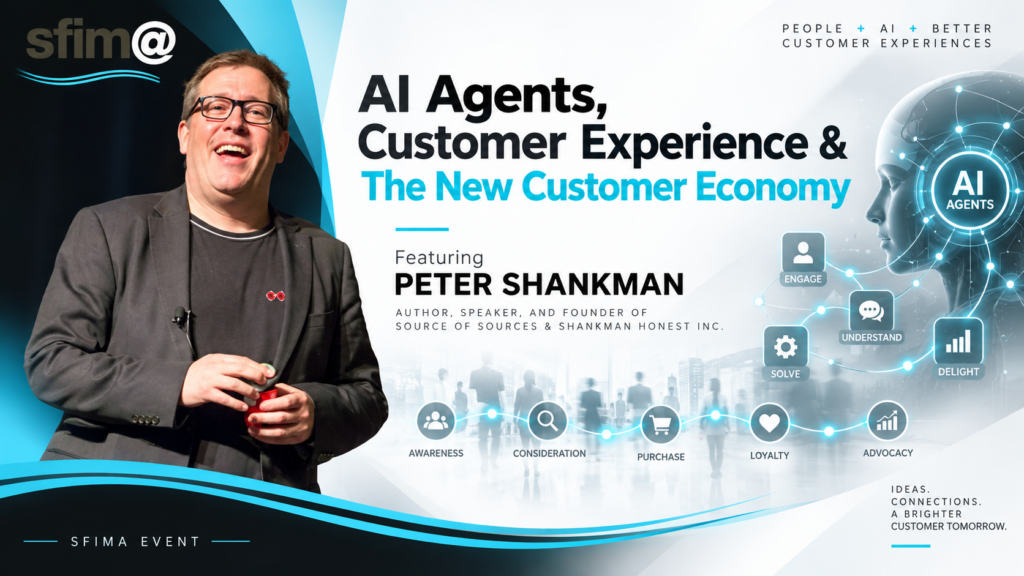
That is why the intersection of AI, operational excellence and customer loyalty is becoming one of the most important conversations for marketers and business leaders today—and why it will be front and center at SFIMA’s upcoming event, Customer Experience, AI, and The New Customer Economy, featuring customer experience expert Peter Shankman.
From Answering Questions to Solving Problems
A recent CX Network article, How AI agents drive process excellence—and why it matters for CX, highlights an important shift in how companies should think about artificial intelligence.
AI agents aren’t simply another customer service channel. They can increasingly execute tasks autonomously, interact with business systems and help deliver an end-to-end resolution.
Think about the difference.
A traditional chatbot might tell a customer how to change an order.
An AI agent could potentially identify the order, confirm the customer’s request, make the appropriate change, update the relevant systems and communicate the resolution—all within the same experience.
For customers, that can mean fewer handoffs, shorter wait times and less effort.
For businesses, however, the opportunity goes even deeper.
AI Can Expose the Processes Behind the Customer Experience
Customer frustration is often blamed on the customer-facing interaction.
In reality, the problem may be happening much further behind the scenes.
A representative may provide great service, but if the company’s systems don’t communicate, policies create unnecessary friction or employees must navigate five different platforms to solve one problem, the customer still experiences the consequences.
Agentic AI can force businesses to examine these workflows more closely.
Where are customers repeatedly getting stuck?
Which requests require unnecessary manual intervention?
Where are employees spending time moving information between systems instead of helping customers?
Which processes create repeat calls, emails or complaints?
These are operational questions—but they are also customer experience questions.
The processes customers never see can have just as much influence on loyalty as the interactions they do.
The New Customer Economy Raises the Stakes
Customers have never cared much about a company’s internal organizational structure.
They don’t care which department owns their problem.
They don’t care which CRM, ticketing platform or database contains their information.
They simply want the company to recognize them, understand what they need and make the experience easy.
AI is raising those expectations even further.
As consumers become accustomed to faster answers and increasingly personalized digital experiences, friction becomes more noticeable.
And when switching to another business is only a search, click or tap away, seemingly small frustrations can have significant consequences for customer loyalty.
That makes process excellence increasingly important to CX.
Companies cannot simply place AI on top of disconnected systems and inefficient processes and expect transformation. The underlying customer journey still matters.
AI Should Give Humans More Opportunities to Be Human
There is another important side to the AI conversation.
The goal shouldn’t necessarily be to remove people from customer experience.
It should be to remove the unnecessary work preventing people from delivering a better one.
When AI handles repetitive administrative tasks, retrieves information, identifies patterns or completes predictable workflows, employees can spend more time where human skills provide the greatest value.
Listening.
Problem solving.
Building relationships.
Showing empathy.
Handling unusual situations.
Creating memorable experiences.
The future of CX may therefore be less about choosing between artificial intelligence and human interaction and more about determining where each belongs within the customer journey.
The strongest experiences will likely combine the speed and scale of AI with the judgment, creativity and human connection customers still value.
Operational Excellence Doesn’t Automatically Create Loyalty
Businesses should also be careful not to confuse efficiency with customer experience.
A process can be extremely efficient for the company while still being frustrating for the customer.
That’s where Peter Shankman’s perspective on customer experience becomes particularly relevant.
At SFIMA’s Customer Experience, AI, and The New Customer Economy, Shankman will explore a deceptively simple question:
Why do customers leave—even when companies believe they’re doing everything right?
Through real-world case studies, data-backed insights and his signature storytelling, Shankman will examine what separates businesses customers love from businesses they are willing to abandon.
It’s an important complement to the conversation surrounding AI.
Artificial intelligence can help a company respond faster.
It can automate workflows.
It can analyze customer behavior.
It can eliminate repetitive tasks.
But technology alone cannot determine what customers value most.
That requires understanding the customer.
The Real Opportunity: Use AI to Remove Customer Friction
Rather than asking, “Where can we use AI?” businesses may want to start with a better question:
Where are we making life unnecessarily difficult for our customers?
Then look at whether AI, process improvement or human intervention can solve the problem.
That shift puts customer experience ahead of technology.
It also creates a practical framework for evaluating AI investments.
Businesses can examine moments throughout the customer journey and ask:
- Can this interaction be completed faster?
- Are customers forced to repeat information?
- Are employees spending too much time searching for answers?
- Are departments operating with different versions of customer information?
- Can AI resolve routine requests without creating additional friction?
- When should the experience immediately transition to a person?
- What are customers telling us through their behavior that our processes aren’t showing us?
The answers can reveal opportunities that extend well beyond customer service.
Marketing, sales, operations, technology and customer success increasingly share responsibility for the overall experience.
That is exactly why CX can no longer belong to one department.
Customer Experience Is Becoming the Competitive Advantage
AI tools will continue to evolve.
Today’s innovative AI capability will eventually become tomorrow’s standard business functionality.
What will remain harder to duplicate is the experience a company creates around that technology.
Businesses that understand their customers, eliminate friction and use AI thoughtfully may be able to deliver experiences that are faster without becoming impersonal—and more efficient without sacrificing relationships.
The companies that simply automate existing problems may only make bad experiences happen faster.
For South Florida marketers, business leaders, customer experience professionals and anyone trying to understand how AI is reshaping the relationship between businesses and customers, this is a conversation worth having now.
Join SFIMA on September 17
SFIMA presents Customer Experience, AI, and The New Customer Economy, featuring Peter Shankman.
Thursday, September 17, 2026
6:00 PM – 8:00 PM
General Provision
The evening includes networking from 6:00–6:45 PM, Peter Shankman’s presentation from 6:45–7:45 PM and Q&A from 7:45–8:00 PM.
SFIMA members attend free. Non-members and guests are $25, with the ticket fee eligible to be applied toward an SFIMA membership.
Come explore what AI means for the future of customer experience—and what businesses still need to get right if they want customers to stay.
Original Article: https://www.cxnetwork.com/artificial-intelligence/articles/how-ai-agents-drive-process-excellence-and-why-it-matters-for-cx